

Junction Sense is available as an add-on to customers on our Enterprise plan. Get in touch with your Customer Success Manager to learn more.
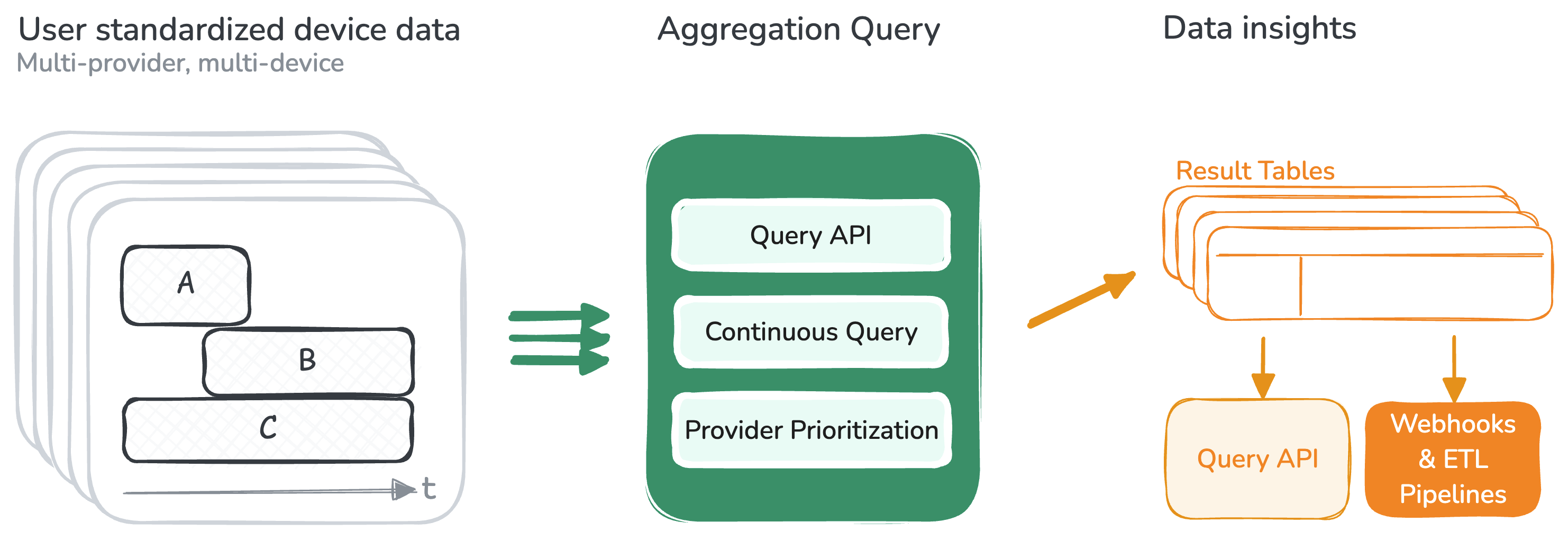
Consolidation
Work with simple tabular outputs, and offload the dirty work to Junction Sense — the data gathering, prioritization, and sanitization
processes across multiple providers and source types.
Data prioritization
Provider priorities can be configured at team level. Query-level priority overrides are also supported to enable
experimentation.
Aggregate in floating time
Work with outputs indexed in the user’s local perception of time. Review the time and data semantics before interpreting daily buckets as elapsed time or data coverage.
Query API and Continuous Query
You can use Junction Sense through two mediums:Query API
- Rapid Insights: Ideal for quick analysis, allowing developers to experiment with individual user data immediately.
- Flexible Outputs: Produces easy-to-use DataFrames that work seamlessly with popular data analysis tools.
- Cost and Time Efficiency: Get aggregated insights without having to dump all user data from the API.
- Build Dynamic Dashboards: Queries are adjustable and executed in real time, suitable for dynamic dashboards that need to support flexible adjustments of queries based on user inputs.
Continuous Query
- Automatic Evaluation: Best suited for scenarios requiring ongoing data monitoring and updates, automatically re-evaluating queries when new data is available.
- Streamlined Workflows: Minimizes manual effort and efficiently manages large datasets, making it ideal for continuous reporting and collaboration within teams.
- Pushed Changes: New and changed query results are pushed to you as webhooks via Svix or ETL Pipelines.
Decision Guide
1
Experiment with Query API
Start with Query API if you need quick insights, one-time analysis or query experimentation using an individual user’s data.
2
Confirm time and source semantics
Check the table index, floating-time behavior, provider attribution, and prioritization before treating an output as a production data contract.
3
Productize with Continuous Query
Switch to Continuous Query once you have queries which you wish to turn into a continuously updated, named dataset and to receive change events for.